Members of the Olympia Weavers Guild gave instruction in hand spinning to students at the Tumwater Middle School in preparation for their Homesteader Program at the New Market Pioneer Fair. Volunteer spinning instructors were Lana Schneider, Patti Logan, Nancy Breckenridge, Debra Sporseen, and Wendy Kough.
Travelers 2014
Gallery
This gallery contains 49 photos.
For the May program, members brought in fiber articles they picked up in their travels and/or family articles that have traveled through time, including some pieces woven 200 years and five generations ago.
Showcase, May 2014
Gallery
This gallery contains 25 photos.
This month’s creations included pin-woven bags, woven shibori, Japanese basketry, “skrunched” inkle bands, backstrap weaving, handspun skeins,knitted dolls, handwoven chair upholstery, and a crazy quilt made with handwoven pieces. The attendees at the Laura Viada Thick and Thin workshop last … Continue reading
Lacey Senior Center Expansion Project: Meet the Artist

Meet the artists and view the art pieces purchased for the Lacey Senior Center Expansion Project, on
Friday, June 6, 2014
5:00 – 6:00pm
Lacey Senior Center
6757 Pacific Ave SE, Lacey
Call 360.407.3967 for more information
Protected: May 2014 newsletter
April 2014 Showcase
Gallery
This gallery contains 20 photos.
Flo Hoppe Workshop
Flo Hoppe Workshop
Northwest Basket Weavers Guild is hosting a Flo Hoppe weekend. She is coming to the Seattle area end will do 2 one day workshops on Saturday and Sunday May 3 and May 4, 2014. These will be held at the Maplewood Rock and Gem Club at 8802 – 196th St SW, Edmonds, Washington.
Flo is a full-time studio artist, teacher, and author. She began her career in 1971 teaching herself basketmaking from a small booklet published in 1924. Her emphasis is on wicker basketry and Japanese basketry. She lived in Japan from 1968-1971, and on a return trip to Japan in 1994 studied with two master basketmakers. Her published books are entitled “Wicker Basketry” and “Contemporary Wicker Basketry”. She has also co-authored “Plaiting with Birch Bark” with Vladimir Yarish and Jim Widess. She teaches and exhibits worldwide, with teaching venues in England, Canada, Japan, Russia, and Australia.
Japanese Basketry Techniques
SATURDAY MAY 3
8-hour class
All levels of weavers
Dimensions: various
Cost: $145 including materials
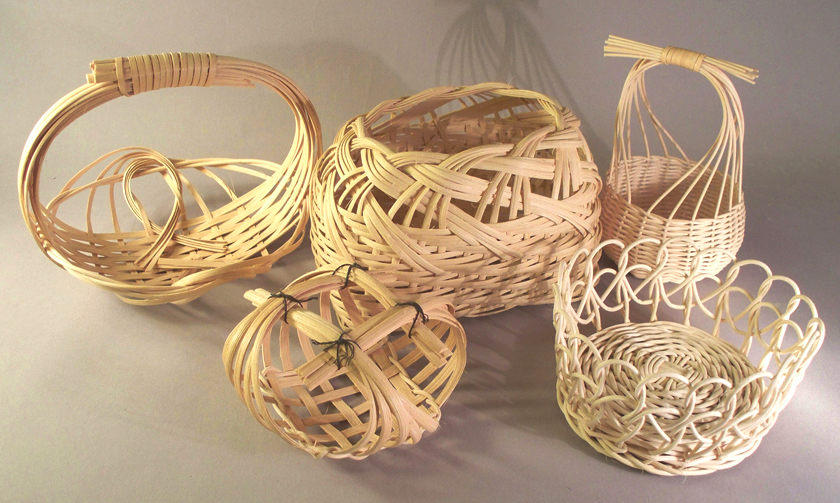
Students will weave 5 baskets weaving with several different techniques using both round and flat reed. Techniques include randing, twill weaves, false twining, and interlacing. This is for all levels of basket weavers.
Brigadoon
Sunday May 4th
8-hour class
Advanced weaving level
Dimensions: 10” diameter x 5 3?4” H
Cost: $125 includes materials
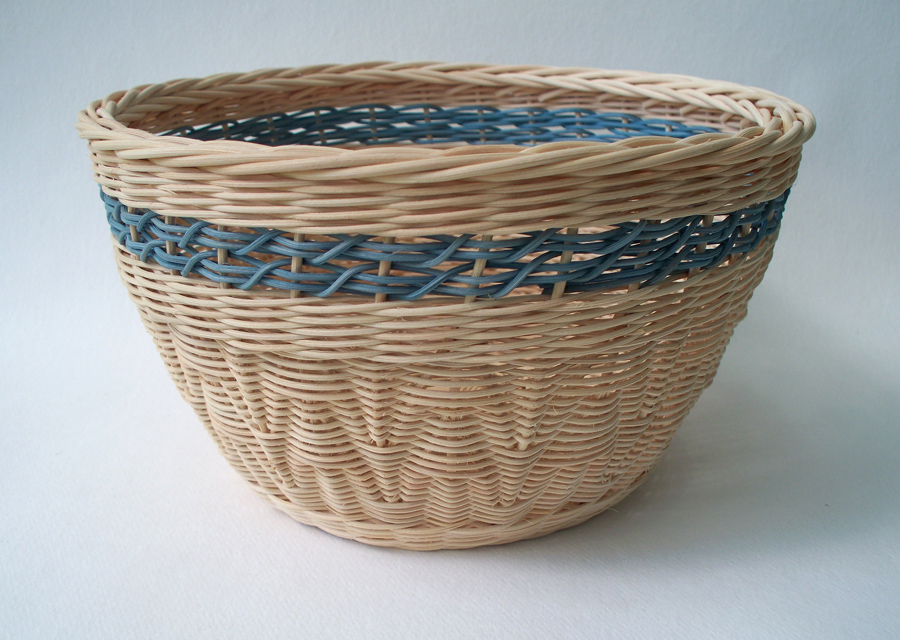
Brigadoon has an unusual variation of chasing weave. Tripled spokes are spread apart on each side of a central spoke to join with a single spoke to again make tripled spokes creating a striking leaf-like pattern. The top band of color is a combination of twining and randing that I learned in Japan from a master basketmaker. The border is a simple 3-row rolled border. For advanced basket weavers.
Flo Hoppe Workshop registration
Classes will be held 9:30 a.m. to 6 p.m. each day, including a lunch break. Please
bring your lunch as there are not restaurants close to the classroom. Chose which class(es) that you want to take:
1. Japanese Techniques on Saturday May 3, 2014 cost is $145 includes materials
2. Brigadoon on Sunday May 4, 2014 cost is $125 includes materials
For questions, more information, or assistance in please contact Jill at jillgreen@mac.com, or call 206 324 4714 or Elaine at a.twogood@att.net
Cancellation Policy: A full refund, less $20 processing fee.
| Name: | Day phone: |
| Address: | Eve phone: |
| City/State/Zip: | E-mail: |
| Class Choice(s) | |
| 1. Japanese Techniques | $145 |
| 2. Brigadoon | $125 |
| Total enclosed: |
REGISTRATION DEADLINE: April 26, 2014
Please enclose a check for the amount of the class or classes that you want to take,
made payable to: Northwest Basket Weavers (or NWBW), and mail to:
Elaine Twogood.
2539 56TH AVE NE
TACOMA, WA 98422
Protected: April 2014 Newsletter
Showcase – March 2014
Gallery

This gallery contains 41 photos.
Taking a Weaving Workshop (video)
Everything you needed to know about taking a weaving class, but were afraid to ask…
This short video shows what it takes to get ready for a weaving workshop. In our Beginning Weavers program, the preparation work of winding and beaming the warp, threading the heddles, sleying the read, and tying on the cloth beam is done in class, but for most workshops, like the one shown here, attendees are given a draft and a materials list and maybe a pre-wound warp before class and are expected to arrive at the workshop with their loom fully dressed and ready to weave. In my case, this was my third weaving workshop, the first being the beginner’s workshop, and the second a card-weaving workshop, where all work was done in class. I’ve done a project at home on a 4-shaft loom, and demonstrated weaving on a pre-dressed loom at the Thurston County Fair, but this is my first 8-shaft project. In this class, we were given a choice of threading drafts a few weeks in advance, and the treadling tie-ups (for floor looms) and lift plans (for table looms) were provided the first day of the workshop. The objective of the class was to demonstrate the effects of different treadling patterns with the same threading.
Note during the video, that each step in the threading and weaving is carefully marked off on the draft or lift plan, and a short sample woven before class to check for and correct threading errors. For long treadling sequences, it is wise to make several copies and mark them as you go. Many weavers keep a metal clipboard with movable magnetic markers to keep track of their progress. For simple, repetitive treadling, most weavers simply memorize the pattern, much like musicians memorize a score, stopping only at the end of a complete pattern repeat. The tools used in the video include a warping frame, lease sticks, raddle threading hook, combination threading/sleying hook, and boat shuttles. Not shown is a bobbin winder to wind bobbins or perns for the shuttles. Many weavers use a cordless electric drill to wind bobbins. I also used a metal bar and clamps to spread the warp while beaming (a creative experiment), but many weavers will use an assistant to hold and tension the free end of the warp, and pass the warp through the harness with the heddles moved to one side. This is warping back to front, as the warp is threaded from the back to the front through the heddles, then the reed.
Weaving in Twill from Larye Parkins on Vimeo.